Giants’ Anatomy
Gary Zhexi Zhang
Gary Zhexi Zhang situates Giants' Anatomy as a near-future reflection on dismantling industry, mourning labour, and turning industrial history into spectacle and museum culture.
Projects


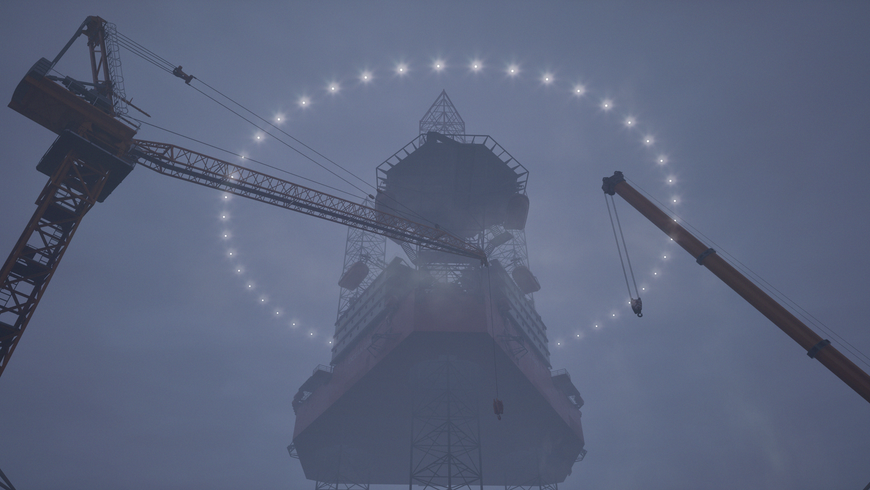
“When the rig is no longer useful, but not yet waste, it is suspended in a cultural limbo waiting to be taken apart, as a show.” — Hantao Li, Giants’ Anatomy (2026)
Laying history to rest is a near-impossible task, especially if you still need to get up the next day. For Britain, that appendage on the Northwestern coast of Europe where industrialisation began, the future (in the very modern sense) is increasingly indigestible precisely because it is so far in the past. At its heart is the metabolism of extraction: of bodies, mines, soils and more, necessary to keep the juices of industry flowing. The 19th century chemist Justus von Liebig referred to Britain as a nation that ‘seizes from other countries their conditions of their own fertility […] Vampire-like, clings to the throat of Europe, one could even say of the whole world, sucking its best blood.’[1] So precious was fertiliser — the transport of nitrogen into the soil in order to sustain the crops that would fuel the working class — that it is said the battlefields of Waterloo were trawled for bones to nurture the fields at home.
The timelines of resources choreograph cultures, landscapes and cities around them. With Britain’s explosive growth, from the shipyards of Glasgow to the cotton mills of Manchester, came the fear that one day, all of this might be over. Already in 1865, the polymath economist William Jevons warned that, despite the miraculous luck by which Britain had discovered coal in abundant supply, the question of running out could not be deferred forever. If preparations were not made for peak extraction, which Jevons calculated as the mid-1960s, the burden inflicted on future generations would be profound.
In 19th-century Britain, the notion of depletion, like extinction, was almost unthinkable. Contemporary futurities are more strategically contoured by scarcity. The discovery of oil in the UAE, for instance, sparked radically different approaches to development between its constituent emirates. Abu Dhabi unearthed 92 billion barrels, while Dubai found only 4 billion, setting the latter on its path towards radical diversification as the globalist financial hub. Another petrostate, the United States, saw its oil wealth grow steadily over the 20th century, peaking in the 1970s, until the Obama-era shale fracking boom turned the world’s number one oil consumer into its biggest producer—surpassing even the Gulf. As Jevons had observed of coal in Britain, the politics and prosperity of the U.S. depends significantly on its control over the price and availability of oil, hence its brazenly imperial coup in Venezuela in early 2026.
It was the 1973 middle east oil crisis that catalysed the discovery of oil in the North Sea, turning Britain into an oil exporter and reshaping the power dynamics of global energy. This timeline peaked in 1999, when the fields between Norway and Scotland were producing 6 million barrels a day (less than half the U.S.’s current output), falling to a sixth of that today, and set to almost entirely collapse by 2050.
“But what should artists do?”, I hear you ask. The de-industrialisation and financialisation of Western economies since the 1970s was mirrored by the aesthetic derealisation of postmodernity and the seeds of contemporary art. Ford’s factory gave way to Warhol’s, and so industrial zones from Birmingham to Beijing found new lease of life as artists’ studios, incubators and creative hubs. (In London’s Old Street development, a building is emblazoned with the name, “White Collar Factory”.) Politics becomes a sub-genre of performance, and performance a way of life. Is this what prosperity feels like, a re-enactment of labour as a proxy for dignity? As Francis Fukuyama pondered at the end of his famous 1989 essay, “The End of History?”, ‘In the post-historical period there will be neither art nor philosophy, just the perpetual caretaking of the museum of human history […] Perhaps this very prospect of centuries of boredom at the end of history will serve to get history started once again.’[2]
Hantao Li’s Giants’ Anatomy is not so much a speculative fiction as what has lately come to be known as “scenario fiction”, a genre typified by Kim Stanley Robinson’s 2020 cli-fi novel, The Ministry of the Future. A scenario fiction offers not dramatic, utopian or dystopian counter-propositions to the conditions of technology or social order, so much as brings to life believable visions of the near-future, almost mundane in its realism, like a prototype that, by demonstration, expands the aperture of the present.
In Li’s film, a millennial journalist returns to his hometown of Cromarty, coastal Scotland, to bear witness to the decommissioning of a North Sea oil rig on which his father once worked. But this is no ordinary moment of obsolescence; by community decree, the disassembly of the rig is staged as a kind of ritual, reminiscent of Zoroastrian sky burials, in which bodies would be ceremonially purified before being placed on sacred architectures to be stripped clean of flesh by vultures. Here, the ocean giant is brought back on shore to begin a funereal process by which it is carved up and arranged on the dry dock, its hull and supporting skeleton undone by cranes and work crews with the anatomical attention of a mantis broken down by a swarm of ants. A modern megafauna if ever there was one, the deinstallation of an oil rig is an architectural event. The visible platforms, iceberg-like, form only a fraction of a body which typically stands well over a hundred metres tall, in order to support drilling into the seabed, in places a kilometre deep.
Li is an architect by training, and his virtuosic crafting of composited live action and computer-generated imagery is evident here in near-photorealistic landscapes. Indeed, the entire project feels distinctly architectural, presenting a site of deindustrialisation in action with the cleanliness and precision of a maquette, in juxtaposition to the famously gruelling and dirty nature of rig-work. It’s an uncanny sight, as a port is turned into mortuary for the embalming of a colossus. Li’s journalist narrator is sympathetic yet ambivalent to the ceremony of it all; he serves as a generational bridge between the dismantlement of the past (“along with father’s memories, and his sense of identity”) and an all but certain future. What else to do, but observe?
The film’s own perspective seems similarly equivocal, at once gently optimistic (in a surprisingly sunny Scotland) about the implicit resolution that comes with putting industry to rest, yet wryly skeptical about the gentrification of hard labour into soft power (“The crown of the drilling tower was shipped to London, repurposed as a new building … a segment of the retractable leg joined a traveling exhibition across Pacific island nations”). What remains is the quietude of spectatorship, the slow time of mourning, and watchful seabirds circling the tides of post-history. When all is said and done, there is the museum.
--
Gary Zhexi Zhang is a visual artist and writer whose work explores social infrastructures, technical histories and conceptual systems.
[1] J Liebig, Die Chemie in ihrer Anwendung auf Agricultur und Physiologie, vol 1.
(Brunswick, 1862), quoted in Marxist Ecology in Historical Perspective’, International Socialism Journal, 96, Winter (2002)
[2] Fukuyama, Francis. ‘The End of History?’ The National Interest, no. 16 (1989): 3–18.