Opensecret
Emily Morley
Runner-up for the Michael O'Pray Prize 2025: Emily Morley examines a new mode of distributed filmmaking
Projects

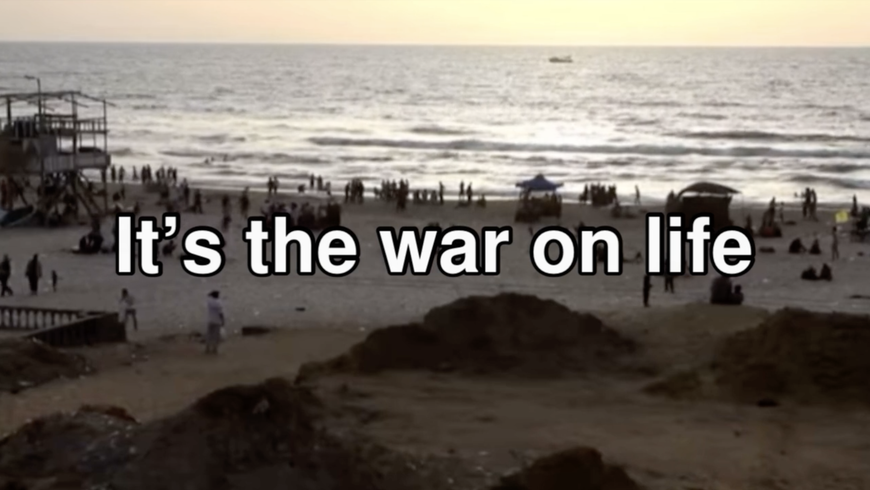
Opensecret (@opensecret) is a peripatetic programme of short films that has been screened in cities such as New York, London, Tehran, Hong Kong, Montreal, Milan, San Sebastian, Budapest, Skopje, Warsaw, Abu Dhabi and Lisbon. Screenings are typically convened at studio spaces, storefronts or, where necessary, private apartments to evade censors. The programme is a ‘minor cinema’ native to the digital social networks it draws on; a fact underlined by how the film’s directors are only known by their online usernames – Y7, Poorspigga, AI Dubai, Marble Index, Xafya Lovecraft – who are loosely linked to one another by affiliated para-academic communities that stem from online platforms and organisations such as ‘Do Not Research’ and ‘Becoming Press’. Their aesthetic signatures are immediately recognisable: hidden identities, avatars, blur, overexposure, internet-ripped footage, hyper-speed editing and a dense, albeit rhetorical engagement with theory.
The circulation of films has emerged out of group chats, Instagram exchanges and iterative edits of existing material: Opensecret’s circulation is as important as its production, or rather its production is one of circulation. These films are created through a networked authorship that unfolds in real time; for instance, many of the directors have solicited ‘voice notes’ for voice-overs in a film, given instructions for someone else on another continent to film scenes, or embedded callouts to other contributors within their films. This ‘networked authorship’ creates a certain engagement with the politics of opacity, from Edouard Glissant’s ‘right to opacity’ and Hito Steyerl’s ‘poor image’ to Bernadette Corporation and John-Luc Godard’s docu-fiction/video essays and the rhetoric of post-cinema that privileges distributed forms of agency over ideas of auteurism. But, as Opensecret’s programme travels, its ambitions reveal a more complicated reality. The films promise the dissolution of authorship, yet they also rely heavily on a set of references and restricted visual vocabulary shaped by the very infrastructures they hope to evade. The result is a tension central to the programme – can a post-cinematic collectivity produce images with weight and consequence, or do the films merely reproduce the thinness and alienation of the digital spaces from where they arise? This tension is most clearly felt in the work of Dana Dawud (@dansdansrev), a Palestinian artist living in Dubai and primary organiser of Opensecret. Her films Palcorecore and Monad anchor the programme, the former by demonstrating the potential of this ‘minor cinema’, the latter by exposing its limits.
Palcorecore is the most arresting work in the Opensecret constellation and makes the strongest political claims. Dawud describes it as a ‘bastion’ against the reduction of Palestinian life to a ‘death-image’ that repeatedly circulates across Western media and strips lives to one of suffering. Her filmic response, what she calls a ‘martyr-image’ – loosely drawing upon Gilles Deleuze’s theories of the ‘time-image’ that centres those who witness and make perceptible the conditions under which they live – is further grounded by Dawud’s thinking around the Arabic word ‘shahid’, which means to witness or testify. Palcorecore asserts the presence of the living.
In the film we see a deaf Palestinian man wordlessly reenact how he defended his street from attackers; a 1980s broadcast that shows PLA fighters dancing on a television studio stage; VHS static rippling across found footage. The film’s narration – a synthetic, girlish voice – floats over these fragments and says, provocatively, ‘there is no genocide, there is only love’. A horse gallops along a beach, mounted by a PLA fighter who looks at the camera with the attitude of a hero; children tumble through the air in what appears, for a split second, to be free fall, until the sequence resolves and we see that it is parkour across rooftops. The film is held together not by narrative but by a sense of life erupting against its erasure.
Towards the end, without warning, we get a glimpse of the narrator: a grainy webcam records a masked, anime-girl figure in a dark room. With the strange irruption of an appropriated and displaced Asian femininity, the narration of archive material speaks to the uncanny nature of making art about Palestine from Dawud’s home in the virtual city of Dubai. Palcorecore retains a commitment to embodied risk. Its archival and found materials are not used to gesture vaguely at politics but to assert a continuity of Palestinian will, motion, play and futurity. In this sense, Dawud offers an answer – partial but real – to Serge Daney’s lament in his reading of Jean-Luc Godard’s Ici et Ailleurs, 1976, that ‘there is no complex image of Palestine, there is only the word Palestinian’.
Palcorecore constructs that complexity through a juxtaposition of momentary, contemporary ‘fried’ internet imagery – it refuses to let Palestinian life be legible only as loss. The film also highlights a contradiction: although Opensecret emphasises anonymity and distributed authorship, Palcorecore is unmistakably authored. Its editing decisions, juxtapositions and tonal calibrations are specific, controlled and grounded by lived experiences. Paradoxically, it is precisely because Dawud assumes responsibility for the image – marrying it to an unexpected visual source, rather than dispersing it – that the film holds political form. Palcorecore alone demonstrates what Opensecret claims to do: create a post-cinematic archive capable of resisting the violence of representation. It succeeds not because it dissolves authorship, but because it accepts the burden of it.
If Palcorecore shows the strength of Dawud’s vision, her film Monad – now in its fourth iteration – reveals the fragility of Opensecret’s wider post-cinematic methodology. Monad is assembled from blown-out iPhone camera flashes, chrome bikinis on blurred girls, overexposed nightscapes and recurring references to the character known as the ‘blurring expert’ who is engaged in digital self-erasure. Its references are explicit and numerous: Steyerl’s work on circulation and degradation, Glissant’s opacity and the ‘three Bs’ – Georges Bataille, Roland Barthes and Jean Baudrillard – whose names appear not so much as conceptual frameworks but as stylistic markers.
Dawud posted to her Instagram the methodology of Monad: ‘outsourced footage distributes authorship’ and ‘image and text shift according to online’ space. Like much art, writing and film that attempts to speak to digital life, the work suffers from the conditions that it describes. The constant re-editing for each new screening, once meant to mimic the flexibility of online content, creates a fugitive instability that undermines coherence without generating new meaning. The opacity of blurred faces and washed-out white tones becomes mannered, or a visual shorthand for resistance that never moves beyond gesture. In comparison with the physical risk embedded in Palcorecore’s found footage, Monad’s performers are affectively and physically inert. They stand before their cameras, half-hidden, half-exposed, moving languidly in front of the Manhattan skyline. For example, a Tumblr-handsome thin man films himself through his MacBook while smoking and wearing a Union Jack T-shirt; his drawl stretches across the clip. It is an image that would be effective in a three-second Instagram story, but it does not hold for several minutes on a large screen. By relying on the theory posted in the surrounding commentary, the film externalises its conceptual labour, expecting essays and online discourse to supply the depth absent from the frame. Its weaknesses are an aesthetic demonstration of larger problems – in a world of digital avatars, everyone involved contributes, yet no one commits. Dawud has framed Opensecret as an experiment in ‘distributed authorship’, an attempt to displace the singularity of the director in favour of a networked unfolding of images. But this framing obscures an older truth: cinema has always been a distributed form, from the interlocutors in documentary to the hundreds employed in studio productions. Edits, performances, translations and accidents all shape a film long before it reaches a screen. To claim that authorship is dispersed is not inherently radical.
Opensecret references Bernadette Corporation’s Get Rid of Yrself, 2003, a documentary on the Genoa ‘Black Bloc’ political riots that uses anonymity not as a stylistic flourish but as the consequences of political reality. An interviewee describes the experience of the riot: ‘You don’t see much, your vision is impaired … there’s a general opacity because everyone’s masked.’ Godard’s narration in Ici et Ailleurs makes a related point: ‘There are moments in time where one sound takes power over the others.’ In these instances, opacity is not an aesthetic choice but the central condition of revolt.
In Opensecret, opacity becomes a symbol without its underlying necessity. The blurring of faces is not the result of police surveillance or bodily danger; it is a gesture towards the aesthetics of resistance without its costs. Likewise, the rapid circulation of material online is treated as a politics to itself, when it is often merely the logic of these mega-platforms themselves extended into the gallery or screening room. The problem is not that Opensecret fails to dissolve authorship, but that it requires the myth of dissolution to justify its form. The films depend on a fantasy of collective anonymity that is belied by its actual production: Dawud still edits; contributors still make decisions; the programme still reflects specific states, influences and hierarchies. Authorship has not disappeared, rather it has been displaced into rhetoric.
A further issue arises when Opensecret attempts to represent the phenomenology of online life. Much of the programme’s aesthetic is intended to evoke the experience of scrolling on a phone. Yet the phone is not primarily a cinematic device: it is participatory, self-referential; it produces a mode of attention that is personal, addictive and constantly interrupted. When moments meant for the phone are transposed onto a large screen, the scale shifts but there is a gap in the way this experience is translated. This gap of meaning suggests that we might leave behind approximations of an oligarch-mediated experience and instead return to the work of preservation of an archive that is threatened by the enforcement of digital ephemerality, the personal voice, personal fantasy and embodied stakes.
This is why the most ‘alive’ moments in Opensecret’s programme are often drawn from the archive – they retain the vitality and contingency of their original medium. Once removed from this context, however, the images lose intensity. They must be restructured, reframed, reauthored to function cinematically, and this is precisely what much of the programme avoids. The political stakes intensify this contradiction. In an era shaped by President Donald Trump’s second term, the resurgence of digital ID schemes and escalating restrictions on speech and protest, the experience of being online is not merely aesthetic: it is juridical and material. To represent online life effectively now requires an engagement with embodied threat that cannot be addressed through anonymity and opacity alone. Opensecret’s problem is not that it attempts to visualise online subjectivity, but that it does so at a moment when online life is inseparable from physical risk. The programme’s post-internet irony, inherited from early 2020s ‘affectlessness’, which itself was inherited from 2010s alt-lit in New York, is ill-suited to the political environment of the mid 2020s. What was once read as evasive or clever now reads as a retreat.
Palcorecore demonstrates the potential of Opensecret’s project: a post-cinematic work capable of producing political density through montage, opacity and networked production, while still retaining the force of embodied life. But the wider programme reveals the limits of claiming distributed authorship or digital opacity as political strategies in themselves. Without cinematic risk, commitment or formal clarity, opacity becomes mannered, and distributed authorship becomes a fashionable veil. If Opensecret wishes to resist the ‘chain of images’ that Godard warned of, it must move beyond the self-referential aesthetics of the feed and confront the conditions that shape its existence. Otherwise, its images risk becoming precisely what they critique: circulating surfaces, endlessly updated, bearing less and less weight.
Emily Morley is an awardee of the Film and Video Umbrella and Art Monthly Michael O’Pray Prize 2025.
The Michael O’Pray Prize is a Film and Video Umbrella initiative in partnership with Art Monthly.
2025 Selection Panel
- Ed Atkins, British contemporary artist, best known for his video art and poetry
- Belinda Zhawi, literary & sound artist, author of Small Inheritances (ignitionpress, 2018)
- Angelica Sule, director, Film and Video Umbrella
- Chris McCormack, associate editor, Art Monthly
--
Image: Dana Dawud, Palecorecore, 2024