Reinforcements
Rachael Rakes
Rachael Rakes examines how visual technologies have never been neutral tools for revealing truth, but have instead been shaped by systems of power that determine what counts as evidence and reality.
Projects


"They don’t make lies, like they used to.”
- Smog, ‘Lize’
The first architectural plan in photographic scale was commissioned for a German military fortress in 1868. The first aerial photographs of Auschwitz were taken from a US military aircraft in 1944. Intended as intelligence on an I.G. Farben complex, they showed how the factory and concentration camp had already become one and the same site. Prisoners were turned into slave labour or were subjects for medical and chemical testing. A subsidiary of Farben created Zyklon B. As Harun Farocki notes in the essay, ‘Reality Would Have to Begin’ (1988), the incidental evidence of the camp was ignored by the Allies. The text draws on histories of the photographic image’s role in documentation and testimony, and realities of how image-reproduction technology refracts justice and reflects priorities of the powerful. Since that first scalar representation in 1868, the military immediately recognised its uses in creating warfare with the safety of distance from battle. The photographic image could stand in for a real thing, while abstracting its conditional reality.
Previous to Cues, and amid a suite of multimedia works on machinic vision, reproduction, and evidence, Anna Engelhardt’s multimedia work Death Under Computation plots additional points along the trajectory Farocki draws. Technologies of photographic measure combined with systems developed for Cold-warring to create Cybernetic Weapons in Soviet Russia. Dubbed ‘location machines’, they could take the precise measurements of aerial mapping to see targets rather than places. Later, digital maps, adding Radar and GPS to this scalar grounding could portray ‘space as voids’ leaving only the desired elements for military power to extract, terminate, or speculate without interference. Heavy doses of distance and abstraction make it easy to do harm without remorse.
In the century of violence that cemented the US’s demographic identity as a bloated proto-Euro Disney, these two concepts jelled and activated into a machinic ideology, and eventually an ideologic machine. Backed by a manifesto void of an argument, the forefathers’ sons employed a cartoon version of the bestselling book, The Secret, pioneering a right to dominance because God said, off the record, that it was a good idea. Willingly confusing destiny and tautology, Western expansion did its work from an ideology of willful ignorance that effectively destroyed everything in sight, even speculatively. It led settlers to abstract themselves, placing Euro-Americans – for the record, I’m one of them – in a trap of distance from spaces of memory, groundings of ancestry, knowledge of how to live with a land, or reliance on community, We became bereft of desiring any such connections, and even more bereft of empathy with those living instead still on the ground. Civic Terminators, living poorly off the fumes of American dream tautology, and the convincing marketing strategy still bringing dreamers into the trap.
At the continental edge of destiny was Los Angeles, which since Spanish colonialists first started building missions in the indigenous communities inhabiting the basin for an unimaginable 12000+ years, exceptional measures of hope, coping, and destiny have been pumped into its grounds. Placed in the one US state to take the American Dream meme and add a sunny, fertile, customization option, the city was built by imposing yet another fictive terra nullius narrative over its graves. Its main industry – along with munitions building – made that delusion into cosmology. Assisted by universalities of western rational thought and tropes of its folklore, Hollywood has instilled the terms on which the real and the fictive are communicated and reiterated.
In Thom Andersen’s 2003 essay film Los Angeles Plays Itself, a voiceover relates how director Nicholas Ray, for the 1956 Hollywood teen drama Rebel Without a Cause, “photographed real locations around Los Angeles to look like sets in a studio musical.” The staged-in-the-real teen universe of the film posed a hypothetical dystopia to a postwar audience of a new suburban youth armed with discontent and cars. Hollywood’s mutual existence within and abstraction of that same city is one of Andersen’s urgent concerns. If one of the most embattled and manufactured lands on this earth is also the most photographed, most audio visually represented, and host to the industry responsible for proliferating narrative ideology, what happens to those actually living there, facilitating continuity. The film’s narration unfolds over hundreds of movie clips depicting the city’s surfaces and interiors in various periods, grades, and genres, and infrequently playing themselves.
Some of the same films appear in Cues, Anna Engelhardt’s examination of the lie detector as a device legitimised over decades in both US law and culture despite its known failure to measure or extract truth. In postwar/Cold War Film Noir and procedural dramas, the machine shows up to add an element of technological realism that serves narrative tension and offers an exciting view into police investigation tactics.[1] It’s important to note here that, even for the US, the police have long held a remarkable power over Los Angeles, and was already rife with corruption and effectively immune from reform before the movie studio industry boom. In Los Angeles Plays Itself, Andersen asks, “Can there be a movie about Los Angeles that isn't about its police?”. His essay is as much about social erasure and evacuated landscapes as it is about the LAPD, proving its own point.
A 1913 Supreme Court decision justified the state’s right to censor films on the basis that they were not art, and thus not subject to first amendment rights defending expression. It describes films as “mere representations of events, of ideas and sentiments published and known; vivid, useful, and entertaining, no doubt, but… capable of evil… the greater because of their attractiveness and manner of exhibition.” OK, this rings of early moving image naivety, even if that’s always been overstated, but this description maps the contradictions to solidify in mainstream cinema’s power (for what it’s worth, it also resembles debates lingering around the contemporary documentary industry). Faroki outlined how the image could be weaponised due to its ability to abstract. Combine this with studio filmmaking’s hollow, recursive tendencies, and it’s possible to imagine film’s power coming from seeming not to have a message. Three years before the court decision, the LAPD had shut down every cinema in the city arguing that without their advice over script and story, films might incite more crime in a crime-filled city, which the force was also encouraging for a fee. Perhaps all of those depictions of dumb cops actually belies some long game strategy on the police institution’s end.
The US State Department began weaponising culture on a global scale in the war years. By the 1940s, the Military Entertainment Complex produced and distributed heavy handed propaganda, but police and carceral power really reveals itself when zooming out further. Seeing films as devices distanced from their own referents, and centralising global entertainment meant deciding the definition of narrative form and content, and its ostensible counterpart, reality. Lifelike, airtight versions of fictional worlds that are true within themselves is a hallmark standard for a Hollywood film. Since three-part structured narrative has become the default genre of film, or its metonymy, the endurance of this virtue of fealty has instilled a complimentary burden on documentary film, and any splinter genre, retrofitting reality representations into narrative arc form.
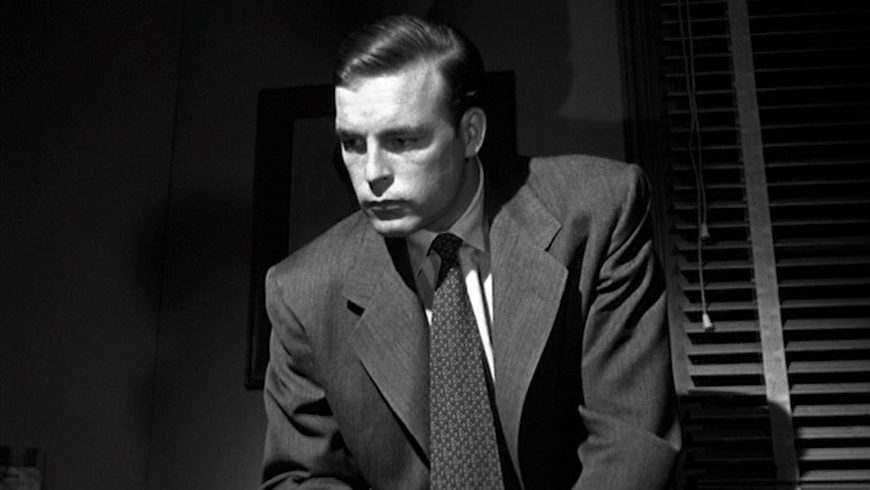
Cues catalyses its ideas on cinerealistic lies, not from narrative film, or what has been deemed ‘film’ in general, but from a then-nascent Hollywood mashup genre, the docudrama. The form searched for its stories from the news, retelling the real life events with some creative agencies. A puncture point of Cues comes via a fairly mid example of the form, the Jimmy Stewart vehicle Call Northside 777 (1948.) Based on reporting from two journalists who managed to get a working-class Polish man charged with murdering a Chicago police officer released from prison after ten years, the film focuses on the dramatic events of truth-finding on behalf of the reporter(s) (compressed to one man in the movie). In a tense, sweaty scene, the accused man endures a lie detector test, which characters in the film refer to ominously as “going against the box.” He passes it, and did in the actual case too, but the result of the test in both real life and docudrama were not admissible as official evidence. In the film’s story, however, the test holds an-extraofficial weight, it proves to the journalist a kind of essential goodness and emotionally sways the reporter to continue fighting the case. While this kind of dramatic flourish is understandably part of the genre, one of the film’s total fabrications is the discovery of… a photograph. This single image is also the most convincing piece of evidence in the trial.
It feels incumbent on me to recall the 1991 Rodney King incident here, a contemporary event that marks a point of no return for, among other things, reforming US policing or eradicating the structural violence committed by the state against Black Americans. A Los Angeles citizen’s video recording of the relentless assault on King by four cops, while bystanders shouted, “don’t kill him,” was picked up by local news and instantly circulated around the world. The trial to follow essentially acquitted the cops, despite there being no question as to the validity of the recording, which looking back from here seems foretold, but many at the time could feel it already. In an essay published soon after the trial, theorist Judith Butler articulates a certain inevitability in the absence of justice, that when “there is a racist organization and disposition of the visible, it will work to circumscribe what qualifies as visual evidence, such that it is in some cases impossible to establish the "truth" of racist brutality through recourse to visual evidence.” The destiny of the US is to be racist, so its destiny is to lie; the semi-tautology she traces is unbearable.
I’ll close this by diagramming a question from the present.
Is Artificial Intelligence real, or is it just a bubble?
The Turing Test was created to assess whether a machine responds to human communication convincingly, but popular knowledge goes that if an intelligent machine passes, it thinks. Compounded by the persistence of Descartes’ old tautology, this then suggests potential realness. A passing Turing result is enough for Corporate AI to assemble fictional capital towards media coverage on computational technologies’ newest greatness and/or scariness. Tech reporting of 2020s days tends to pose an insincere headlining question on behalf of its consumers, and AI fueled journalism tends to repeat the questions relayed in other news. The flood of these pieces then triggers financial media to reiterate the take that AI is definitely a bubble. Is an economic bubble not real? Historically when bubbles burst, a whole lot of reality happens. Putting aside that bubbles burst only when most people are deceived about them, rather than routinely let in on the secret, AI being a bubble pre-correlates the technology to its speculative capital hype. One biannual story appearing across various media outlet ledes is the prediction that Large Language Models will soon become more effective than lie detectors in establishing innocence or guilt. We have to change reality. Large Language Models will soon become more effective than lie detectors in establishing innocence or guilt. We have to change reality.
--
Rachael Rakes is a curator, writer, editor, and film programmer. She is also a lecturer at Parsons School of Design, New York.
Footnotes:
[1] Several filmmakers in this genre also sought to use this picture of realism to subtly expose corruption and injustice in US policing and judicial systems. Subtlety was less a choice than a need to elide edicts like the Hays Code -a set of self-censorship guidelines initiated in the 1930s that prefigured the Hollywood Blacklist. In this context, it's sensible that depicting arrest, trial, and interrogation scenes as accurately as possible would protect from accusations with the support of the truth.
References:
‘American Exceptionalism: From Stalin with Love.’, Aeon.
‘The Origins of the California Dream.’, La Vie des Idées.
Anna Engelhardt, ‘Machinic Computation.’ https://machinic.info/Computation
Judith Butler, ‘Endangered/Endangering.’ 1993
Los Angeles Plays Itself. Directed by Thom Andersen. 2003.
Harun Faroki, ‘Reality Would Have to Begin.’ Sabzian. 1998.
Joanna Zylinska, ‘The Perception Machine: Our Photographic Future between the Eye and AI.’ Cambridge, MA: MIT Press, 2023.
Donald Scott, ‘The Religious Origins of Manifest Destiny.’ Divining America, TeacherServe. nationalhumanitiesCenter.org.
Jennifer L. Mnookin and Nancy West, ‘Theaters of Proof: Visual Evidence and the Law in Call Northside 777.’ Yale Journal of Law & the Humanities 16, no. 2. 2