THROUGH A MIRROR, DARKLY: Risk, Mediation, and the Glass of History
Adnan Madani
Adnan Madani's text examines a world saturated with mediated images of violence, revealing how perception is shaped by power and spectacle.
Projects

I. Looking as Withdrawal
What kind of looking is possible today? The question—posed by Irit Rogoff a quarter of a century ago–haunts Naeem Mohaiemen’s film, THROUGH A MIRROR, DARKLY. Rogoff asked, crucially, what it means to look not only at images, but also to look away from them: to withdraw from the field in which the image expects to be met, to refuse the choreography of spectatorship itself. Such a turn is not a retreat into blindness; it is a displacement of the visual contract that sustains spectacle. Already then, the real question was one of after-ness: what happens after an endless cataloguing of injustices, structural and epistemic, has been set into motion, and bringing to visibility has become the dominant form of redressal available to both the social and aesthetic realms? Looking away, refusing the coercions of aesthetic power and its institutions, was an answer of sorts–provisional, tactical and timely.
Yet now, its not so clear what it is we are turning away from. Where 25 years ago, the circus of news entertainment was restricted to cable networks, images of violent injustice circulate today in the frenzied economy of images : phone camera footage of migrant camps, bombed out hospitals, flattened schools, severed limbs, starving bodies, bodies that know they are going to die soon, bodies that act as if death cannot inflict on them anything more grievous than the indignity of moral cowardice, than the act of turning away from a genocide. When these images, algorithmically intensified, greet us first thing in the morning and then again in a doomscroll at night, what does it mean to be a spectator anymore? Is the act of refusing to look away, of continuing to feel compassionate pain, in itself a theoretical attitude? Are tears a form of praxis?
Mohaiemen’s title foregrounds the dilemma: the mirror itself is darkened. The apparatus of seeing no longer promises clarity; it returns to the viewer a warped and partial image, a shade or a shadow. To look, here, is perhaps to accept opacity as constitutive, not accidental. To look away becomes a strategy: an abstention from the consolations of spectacle, a method of refusing what Rogoff calls “participation through consumption.” To look away from an image that expects and demands our gaze is to contest that distribution of the sensible that Ranciere sees as the ground of the political. Mohaiemen’s dark mirror names the space where that exposure to the sensible, to the image of the real, is already mediated, already distorted by the very surfaces that promise connection. To look away is both a crime and a necessity.
II. Risk, Rupture, Duration
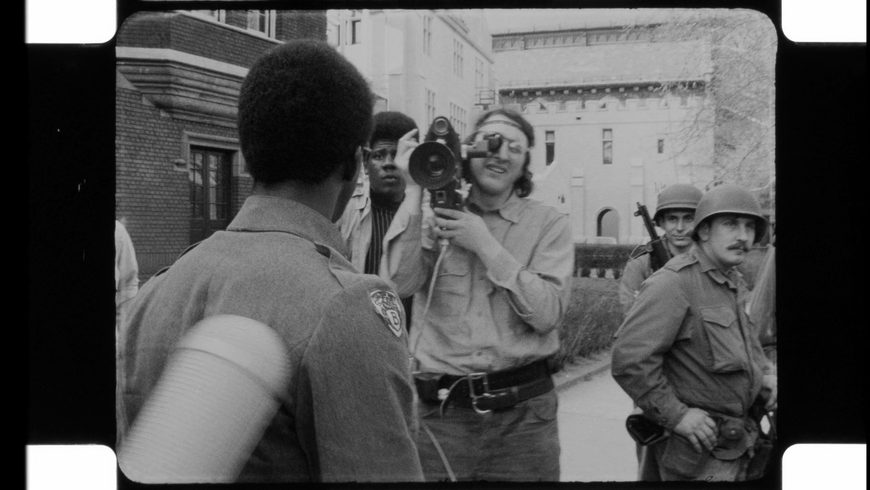
The film re-opens the scene of the Kent State shootings of 1970, a hinge-event in the US anti-war movement when the National Guard fired on unarmed students. The students had not marched toward death; death arrived as a rupture in the presumed contract between civic dissent and state restraint. Their shock registers not anticipation fulfilled but an abrupt collapse of distance between protest and live fire. This violent proximity was recreated just 10 days later at Jackson State University, this time with a majority of Black students, where the two dead and 11 wounded quickly faded from national memory; demonstrating a colonial society’s actuarial acceptance of sudden death and brutality as the natural conditions of racialised life.
Risk, then, is not a willingness to die but an acknowledgement of the possibility of being killed. It takes place within a deeply racialised sense of the risk that is considered ‘natural’ to a way of life, a group of people defined epidermally, genetically or culturally. To equate risk with the certainty of death—an equation that becomes at its limit, suicide—abolishes contingency; revolution, by contrast, requires it. This is the working out of an unfinished revolution: the revolutionary must endure so as to stretch the instant of rupture into a duration of organisation and survival.
(Here one might recall Georges Sorel’s reflections on the myth of the general strike where the disruptive image galvanises but cannot substitute for prolonged struggle; or Étienne Balibar’s Violence and Civility (2010) on the “citizen-subject” who negotiates between political action and the thresholds of legitimate violence.)
Risk in Mohaiemen’s register is temporal as well as corporeal: the wager that survival can hold open a horizon beyond the single event.
III. Taste and the Curation of Grief
Judith Butler’s account of grievability—lives recognised as worthy of protection and of mourning – helps clarify why the Kent State deaths struck the American public as intolerable rupture: these were recognised subjects, made suddenly killable. The film’s sombre pacing links that historical breach to the present in which the calculus of grievability remains uneven.
If earlier movements risked erupting in the street, contemporary resistance often appears absorbed into culture—ritualised, aestheticised, rendered legible through the circuits of taste. Public grief today is curated much like exhibitions or social-media feeds: framed, hash-tagged, distributed, yet rarely allowed to disturb the infrastructures that require the loss.
Mohaiemen’s film lingers on this paradox. We have learned to consume images of suffering as aesthetic objects: carefully toned press photographs of drone funerals; monochrome posters for disappeared activists; candle-emoji vigils on screens. Grief circulates as a token of moral credit. Butler’s question—who counts as a life?—returns as: whose loss circulates, whose vanishes without record. But also, whose grief is exculpatory, whose grief is itself grievable? The obvious answer in this film as in many other analyses is that it is the non-white body (the dead at Jackson State, the millions of Vietnamese dead in the American war) that remains ungrieved and un-memorialised. We know this to be true, but what could change this inequity apart from well-meaning attempts at redressal and restoration of balance? What consolation would such a redressal bring if it were even possible?
Lauren Berlant’s Cruel Optimism diagnoses the attachment to those very forms—images, slogans, rituals—that promise affective consolation while sustaining the impasse. In Mohaiemen’s dark mirror such gestures appear as a surface balm that forecloses rather than enables risk. The student radicals of the 1960’s and 1970’s that we see in this footage, lean and hardened by war and killing, pitiless and ravaged, find a faint echo in the collective resistance of campuses today, in choral harmony, holding hands, eyes downcast. An industry of polite solidarities emerges to work through the trauma of a racialised world, seen through the traumatic grief and guilt of the very world that racialises.
Meanwhile, the vectors of actual violence—drones, algorithms, screen-based targeting—render the truly exposed body peripheral. As Achille Mbembe notes in his work on necropolitics, contemporary sovereign power often governs through the capacity to decide exposure to death at a distance; the victim’s body is encountered as mediated trace before it is met as flesh. Necropolitics, if it is not to be as banal as just the reverse of biopolitics, or the return of good old-fashioned sovereign killing, must be understood as the violence required to produce a fraught consensus that some of us must die so that we can flourish fully. This consensus is not disrupted by the visibility of murder or even genocide; nor is it disturbed by the exposure of its own workings. But still – what is to be done with this image that refuses to go away, that screams for attention, that refuses to let us look away?
IV. Boomerangs of Form and Force
Aimé Césaire’s Discourse on Colonialism described how colonial brutality, once tested overseas, “boomerangs” back to the metropole. Foucault similarly traced the internalisation of colonial war-making within modern state policing. And as Ann Laura Stoler points out, the governance of bodies and affect persists long after formal empire ceases to exist.
Mohaiemen’s provocation is that not only the violence of colonialism, but even the rituals of resistance return home altered—emptied of immediate risk, performed as heritage gesture. Sit-ins, teach-outs, die-ins often remain legible primarily as symbolic acts calibrated for media uptake. The neoliberal present, as the film intimates, constrains not the capacity for grief but the capacity for refusal: one may mourn yet rarely step aside from the labour and consumption that finance the very order mourned.
V. Left Melancholy and the Archive
Walter Benjamin, in his 1931 essay on “Left-Wing Melancholy” warned of the revolutionary who clings to past emblems of struggle in lieu of altering present conditions—an attachment to defeat that becomes aesthetic posture. Wendy Brown revisits the term as a pathology of political culture: a fidelity to loss that blocks the imagination of change. Importantly, Mohaiemen’s attention to archives, fragments, rubbings, analyses and risks this very impasse: remembrance substituting for continuation. Where Mohaimien’s work separates itself from the melancholic passions he documents, is in constituting an analysis, a connection of moments and melancholic traces that might serve to produce something that surpasses the act of looking back and being faithful to a singular movement or moment in history.
At the same time, the film’s fragmentary method acknowledges what Saidiya Hartman calls the “violence of the archive”—its silences, erasures, coercive frames—and the necessity of what she terms critical fabulation to animate the excluded. The dark mirror asks whether acts of preservation can avoid hardening into a narcotic loop: memory as closure rather than provocation. But under Mohaiemen’s cool gaze and assemblage of materials as diverse as testimonies, remembrances, memorialisations, popular cultural narratives and political speeches, it becomes equally clear that forms of fabulation have always been at the heart of how we remember and memorialise events: criticality and the capacity to counter fabulate are not in and of themselves sufficient to bring about a revolutionary moment, or indeed a revolutionary consciousness. Contingency, accident, mediation, misremembering feed into any view we might have of the most recent and the most distant past; the archive is not emancipatory here, and the film is neither a memorial nor a counter-memorial but something altogether different, holding together doubt and certainty and refusing to draw a straight line from a picture of injustice to a vision of justice.
VI. Reification and the Dark Glass
Here Marx re-enters, not as relic but as analytic insistence. Jaleh Mansoor’s Universal Prostitution re-reads Marx’s concept of reification—the abstraction of living labour into value—through the lens of post-war abstraction in art: opacity not as stylistic caprice but as symptom of a world already abstracted by capital, where the commodity-form renders social relations themselves as thing-like, alien, exchangeable. In Mohaiemen’s film the darkened mirror is precisely such a reified surface: the image refuses transparency because its very substrate is caught in circuits of exchange and remembrance.
The film’s recurring motifs—archival rubbings, the faded photograph, the grain of monochrome video—expose rather than disguise this entanglement. To make a rubbing of a monument is to touch history as trace while recognising that even the trace has entered a regime of circulation and display.
VII. Dialectical Image
Benjamin’s notion of the dialectical image—“where the past flashes up in a constellation charged with the present” offers a lens for the film’s staging of fragments. Mohaiemen’s interleaving of an artist’s performance piece—hesitant, gestural, unfinished—with images of gravesites, archive photographs, and screens does not weave a seamless continuum of history. Instead, it holds the fragments in charged suspension, allowing contradiction rather than resolution to become visible.
The performance appears slight, even fragile. I’m puzzled by its strange faintness amidst the charging and charged moments that surround it, by its preciousness and hesitancy, and yes by its self-consciously artistic privilege in a hostile or impassive city. Yet in its incompleteness, or less than present presence, it perhaps enacts the dialectical pause: a momentary stand-still in which antagonistic temporalities confront each other without synthesis.
VIII. Against Consolatory Memory
To archive, commemorate, preserve—these gestures remain necessary for any politics of redress. Yet Mohaiemen’s dark mirror warns that such gestures can easily become narcotic substitutes for transformation. The work insists that we attend to what is absent, dis-formed, or refuses return. Memory persists but cannot by itself redeem; risk, not remembrance, must be sustained if politics is to remain possible.
IX. The Time of Analysis
If the time for spectacular rupture appears suspended, perhaps what remains is a time for analysis. Marx’s account of capital as a system of cyclical crisis, resistance, re-configuration reminds us that transformation is rarely punctual; it unfolds in uneven temporalities.
In this light the revolutionary subject appears not solely as street actor but also as historian, analyst, witness—one who sustains the memory of rupture while mapping its unfinished consequences.
Mohaiemen’s film refuses the genre of elegy. It remains a provocation: asking viewers to inhabit distortion without nostalgia for lost transparency; to persist without expectation of triumph; to think as a tactic rather than a retreat—to preserve, even in analysis, the fragile possibility of risk when the mirror stays clouded.
X. Coda
Benjamin tells the story of a picturesque Chinese place, a beautiful cliff where lovers would go to stand arm in arm. Many would then stop for a bite to eat at a restaurant that was fortuitously located nearby, and which prospered through the appetites of these happy couples. One day, a disappointed lover chose this cliff, the site of his happiest moment, to jump to his death; soon others followed his example, and unsurprisingly the restaurant lost all its business.
The restaurant owner, left with nothing, was forced to come up with a plan. He put up an electrified wire at the edge of the cliff where people chose to plunge to their death, and hung a sign that said: “Danger! High Voltage! Risk of Death!”. Soon, the would-be suicides started avoiding this place, and the restaurant flourished again.
--
Adnan Madani is an artist, writer and lecturer in visual cultures at Goldsmiths, University of London.
References
- Balibar, Étienne. Violence and Civility. New York: Columbia University Press, 2010.
- Benjamin, Walter. “Left-Wing Melancholy.” 1931. — “Theses on the Philosophy of History.” 1940. — The Arcades Project. Cambridge, MA: Harvard UP, 1999.
- Benjamin, Walter. “The Warning”. In The Storyteller. London: Verso Books. 2016
- Berlant, Lauren. Cruel Optimism. Durham: Duke UP, 2011.
- Butler, Judith. Frames of War: When Is Life Grievable? London: Verso, 2009.
- Césaire, Aimé. Discourse on Colonialism. Paris, 1950.
- Foucault, Michel. Society Must Be Defended. Paris lectures 1976; New York: Picador, 2003.
- Hartman, Saidiya. “Venus in Two Acts.” Small Axe 12 (2), 2008.
- Lukács, Georg. History and Class Consciousness. 1923; Cambridge, MA: MIT Press, 1971.
- Mansoor, Jaleh. Universal Prostitution: Art and Money. Cambridge, MA: MIT Press, 2017.
- Mbembe, Achille. “Necropolitics.” Public Culture 15 (1), 2003.
- Mohaiemen, Naeem. THROUGH A MIRROR, DARKLY (film), 2025.
- Nancy, Jean-Luc. Corpus. Paris: Métailié, 1992. — Being Singular Plural. Stanford UP, 2000.
- Rancière, Jacques. The Politics of Aesthetics. London: Continuum, 2004.
- Rogoff, Irit. Looking Away: Participations in Visual Culture. London: Routledge, 2000. — “Turning.” In E-flux Journal (2010).
- Sorel, Georges. Reflections on Violence. 1908; Cambridge UP translation, 1999.
- Stoler, Ann Laura. Duress: Imperial Durabilities in Our Times. Durham: Duke UP, 2016.