shot to pieces – for Morisha
Alice Hattrick
Alice Hattrick examines how Sideweighs and Backwords uses glitches, malapropisms, fragmented imagery, and experimental filmmaking to reflect experiences of memory, migration, disability, and mental illness.
Projects


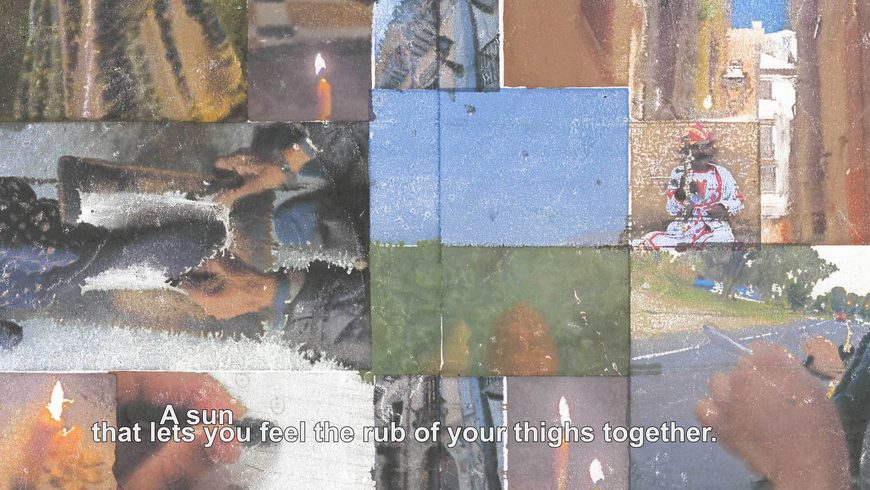
I concentrated on the text the first few times I watched Morisha’s film, so as not to miss any of the mistakes: mis-speech produced during episodes of thought disorder. The text is composed of what is known as malapropisms, instances of using a similar-sounding incorrect word in place of the right one, creating a non-sensical effect.
The words flipped out all wrongly
not that going back is a bad (sad) thing
To smother (mother) the feeling
A malapropism is a speaking out of place. They often stick – a reason to laugh at prime ministers.
The subtitle track plays as if stuck sometimes, buffering. As Mia Mingus has written, access shifts ‘from being silencing to freeing; from being isolating to connecting; from hidden and invisible to visible; from burdensome to valuable; from a resentful obligation to an opportunity; from shameful to powerful; from ridged to creative.’ Here, accessibility calls attention to itself, refusing to be neutral or accurate.
I watched it again, this time focussing on the images: Tall trees, captured from below, the branches full of green leaves swaying. Tiny glimpses of sky. The camera now circling a family member, seated on a chair in a garden, hands folded on their lap, their image sometimes clear, other times almost entirely incomplete, slipping out of existence. A surface that looks like ripples of water, or Decalcomania, Max Ernst’s process of pressing a piece of paper onto wet paint and pulling it away. Then actual water, feet faintly visible, walking in the shallows. A light in the dark. A shrine, perhaps. The images look like murky x-rays or MRI scans. Movement through a landscape, captured from a train or a car. Candles are lit. Images appear in small squares, the screen carved up.
Morisha tells me they often need to squint or even close their eyes when watching a film in the cinema. I play the film again, shut my eyes and listen. Access is an embodied experience.
Here, my body cramped and my head splitting
I think you don’t understand immigrant daydreams
I think you don’t understand what it’s like to live (love) here
Morisha works with mistakes and failure, refusing clarity – of autobiography, of access, of memory. They find pleasure in slippage rather than faithful reproduction. The title of the film – Sideweighs and Backwords – suggests the subtle failures of both movement and language when the bodymind fails, a breakdown of communication and memory in mania, tiny glitches that change everything. To make the film, Morisha selected stills from footage, printed them onto acetate and migrated those images onto paper – what they call ‘bastard monoprints’ – which are then scanned and arranged in a timeline to create a stop-frame animation. The smooth movement of the ‘original’ footage is broken down and stitched back together with the gaps and breaks designed in. They even discovered this process through failure – accidentally printing on the ‘wrong’ side of the page.
The process of making and scanning ‘bastard monoprints’ is more akin to human memory than high-definition video footage, making versions of versions, one sliding into the next. Morisha says their own memory is ‘shot to pieces’, a phrase that references the practice of filmmaking and the fragmentation of stop frame animation. What does access look like when clarity is impossible? This question feels familiar to me. When I write, I rely on my own shaky memory, recovering the words and actions of others in fragments, imperfectly. I meet past lives through incoherent scraps, which just happened to survive. In a world that insists on clarity and certainty, I am interested in the silences and gaps that queer crip lives create.
Morisha’s camera anticipates memory and forgetting. The footage alludes to complex feelings around migration: the artist’s ancestors were forcibly migrated from India to South Africa as indentured labourers on British-owned plantations in the wake of the abolition, and Morisha themselves migrated to the UK as a child. Traditions and languages move with people, but here they are transmitted as disjointed and uneasy, fragmented by displacement and distance. In the absence of a family video archive, Morisha has produced their own, capturing time spent in the three countries their family is connected to and disconnected from – through ancestors, forced relocation (many indentured labourers were unable to afford the cost of return) and adoption. Morisha always knew the images would become a film, the camera a recording device for transformation and transmission as well as posterity, a projecting into future loss that feels less like preservation than a form of care, making an archive out of absence.
This is the movement of in-betweenness, of belonging and not-belonging. It loops and drifts. In The Queer Art of Failure, a book that explores films usually not considered serious enough for study, J. Halberstam describes queer childhood as ‘a long lesson in humility, awkwardness, limitation, and what Kathryn Bond Stockton has called “growing sideways.”’ Morisha’s film is the product of making sideways, or sideweighs, developing ‘along parallel lines rather than upward and onward.’ Sideways development, Stockton writes, is ‘a motion, an emotion, and a growth’, even if it looks like going nowhere. Sideways as in a daydream, and a weighing down, a feeling of being out of time, out of place – a different kind of growth.
Sideweighs and Backwords is also a product of crip time, what Alison Kafer describes as ‘a reorientation to time, not just “extra” time.’ Crip time is flexible time, exploded. It has the power to challenge normative and normalising expectations of productivity and duration. One of the ‘strange temporalities’ – a term borrowed from Halberstam – Kafer describes is ‘anticipatory time’, scanning the future for possible events that could trigger a response based on experiences in the past, a moving forward and backward in time while remaining present in this moment: ‘What has caused reactions before? What might cause reactions now? What reactions lie ahead?’ Anticipatory time requires a different orientation to one’s body and its needs: ‘It is a literal projecting of one's body as a body into the future even as one inhabits one's body in the present.’ The film grows sideways, as linear time unravels, making it speed up in mania and slow in depression, in which it drags on but also moves without you.
The film inhabits what Arthur Frank calls the chaos narrative, the ‘anti-narrative of time without sequence, telling without mediation and speaking about oneself without being fully able to reflect on oneself.’ (Every time I read ‘mediation’ I hear ‘medication.’) Unlike the restitution narrative, which promises recovery, or the quest narrative, in which the person experiencing illness has agency, the chaos narrative never resolves. It speaks to ongoing challenges continually lived in the present, and as such usually goes unheard. Uncertain and fragmented, it fails according to the rules of communication. The chaos narrative doesn’t move toward recovery or redemption and is instead characterised by fragmentation and uncertainty. Sideweighs and Backwords is the experience of living with illness, with no beginning, middle and end.
Relaying the chaos narrative is an act of embracing queer failure, from which, according to José Esteban Muñoz, a generative politics can emerge: ‘Within failure we can locate a kernel of potentiality.’ Muñoz’s description of crip time is also the time of postcoloniality: ‘Those who wait are those of us who are out of time in at least two ways. We have been cast out of straight time’s rhythm, and we have made worlds in our temporal and spatial configurations.’ Every return produces a different reading. Every loop is another opportunity to grasp something more.
I have watched Sideweighs and Backwords many times now. Each viewing leaves something unresolved. I find myself returning to it, the way memory, access and illness are not problems to be solved but endlessly shifting conditions of life. It doesn’t ask for repair, to recover what has been lost. Sideweighs and Backwords asks me to stay with uncertainty, to keep returning.
Morisha’s process of making sideways casts stop frame animation as a crip but also trans medium, requiring transformation, a new version, a new (non-normative) relationship to space and time. Bodies in, out, left, left, right. From footage to photographs, fingers manipulating the image, dispersing it further. A family saves what it can, but the album is a storage device with its own strange temporality – everything captured, frozen in time, but not here. The past, present and future of linear time become vexed, wounded, looping, without resolution. As Frank writes, ‘The wound can only be told around.’
This film is not an attempt at repair, or healing. It is not curative – it gives form to the wound. A buffering subtitle, an image that slips as it is printed, a memory only partially recovered. If the wound can only be told around, then Sideweighs and Backwords is a practice of circling, of endless return and revision, a refusal to resolve the chaos. It is unrecovery in real time.
--
Alice Hattrick (they/them) is a writer and lecturer based in London. They are the author of two books of creative non-fiction published by Fitzcarraldo Editions: Ill Feelings (2021), which examines chronic illness, intimacy and mother–daughter relationships, and Fancy Work (forthcoming 18 June 2026), which reclaims queer embroidery as a form of thinking, living and resisting.
References:
Frank, A. W. (1997) The Wounded Storyteller: Body, Illness, and Ethics, Second Edition, The University of Chicago Press.
Halberstam, J. (2011) The Queer Art of Failure, Duke University Press.
Kafer, A. (2013) Feminist Queer Crip, Indiana University Press.
Mingus, M. (2017) ‘Access Intimacy, Interdependence and Disability Justice,’ remarks from the 2017 Paul K. Longmore Lecture on Disability Studies at San Francisco State University: https://leavingevidence.wordpress.com/2017/04/12/access-intimacy-interdependence-and-disability-justice/
Muñoz, J. E. (2019) Cruising Utopia: The Then and There of Queer Futurity (10th Anniversary Edition), NYU Press.
Stockton, K. B. (2009). The Queer Child, Or Growing Sideways in the Twentieth Century, Duke University Press.